
Hail
Bruised and fractured shingles, granule loss, dented gutters, downspouts, vents, and soft metal flashing.
If hail or high wind hit your St. Louis neighborhood, get the roof documented before the storm date gets stale. We measure a 10-by-10-foot test area on every slope, count and photograph the bruises and breaks, and tell you honestly whether the damage supports an insurance claim. When it does, our insurance division meets your adjuster on site, agrees the scope of work, and manages the claim through depreciation and mortgage endorsement. In most approved claims your only out-of-pocket cost is your deductible. We do not guarantee payouts and we never waive deductibles.
Insurance carriers do not pay for opinions. They pay for documented, measurable damage assessed the same way their own adjuster assesses it — which is exactly how we inspect.
We chalk a 10-by-10-foot area on each roof plane and count bruises and breaks inside it. Strike density per test square is the number that determines whether a slope qualifies.
Every impact, every damaged vent and gutter, soft metals, siding, and window wraps. Hail rarely hits only the roof, and a claim that ignores the rest of the envelope leaves money on the table.
You make the call to your carrier. We hand you the evidence package and tell you plainly whether we believe the damage supports a claim.
Our insurance representative walks the roof with your adjuster and negotiates the scope — replacement of like or kind quality, not a patch on a compromised slope.
Full tear-off, decking inspection, code-required ice and water shield, six nails per shingle, daily cleanup, and a magnetic nail sweep at completion.
Depreciation release, supplements for anything discovered during tear-off, and the mortgage endorsement. Following NRCA installation guidelines throughout.
Bruised and fractured shingles, granule loss, dented gutters, downspouts, vents, and soft metal flashing.
Shingles creased, lifted off the seal strip, or torn away entirely; ridge cap loss; lifted drip edge.
Structural roof damage, punctures, fallen trees and limbs, and decking that has to be rebuilt before shingles go on.
Water forced sideways under shingle courses and behind flashing, showing up as interior staining with no visible exterior hole.
Ice dams at the eaves pushing melt water back under the shingles, plus gutter separation from ice weight.
The same storm that takes your roof usually cracks siding and bends gutters. We restore the whole envelope in one claim.
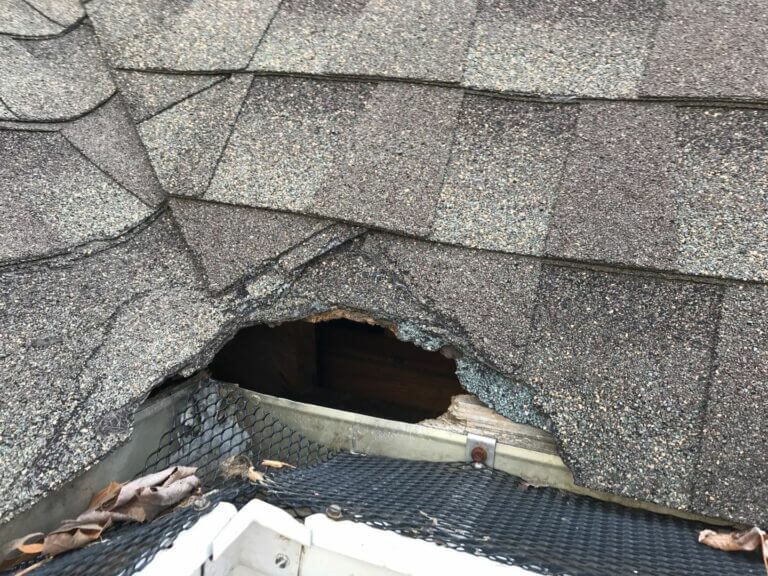
You usually cannot, and that is the trap. Hail damage on asphalt shingles looks like dark bruises where the granules have been knocked loose and the mat underneath is exposed - impacts that are nearly invisible from the driveway but shed granules every rain until the shingle fails. Our inspector chalks a 10-by-10-foot test area on each slope and counts the strikes, which is the same protocol your insurance adjuster uses.
Inspect first. If the damage does not support a claim, you have not put a claim on your record for nothing. If it does, you file with photo documentation and a professional assessment already in hand, which is a far stronger position than a homeowner calling in a guess.
Yes. A dedicated representative from our insurance division meets your adjuster at the property, walks the roof with them, and agrees the scope of work - what is being replaced and at what quality. We also handle the paperwork most homeowners get stuck on: depreciation releases, supplements, and the mortgage company endorsement on your claim check.
In most approved claims the homeowner's out-of-pocket cost is their deductible. We will never offer to waive, absorb, or rebate your deductible - that is insurance fraud, and any contractor who offers it is telling you exactly how they do business.
Out-of-state crews follow hail across the country, sell as many roofs as they can in six weeks, and are unreachable when a workmanship problem appears two years later. John Beal Roofing has been at this since 1947 with offices in Maryland Heights, Chesterfield, Festus, and Edwardsville. There is a permanent local company standing behind the warranty.
Policies vary and many carriers impose time limits measured from the date of loss, so waiting works against you. It also gets harder to attribute damage to a specific storm as more weather passes over the roof. If a severe cell moved through your neighborhood, get it documented while the date is clean.
Send this over and a storm specialist will call to schedule your documented inspection.
Hail documentation and insurance claim help for the cities that get hit hardest.
The damage you cannot see from the ground is the damage that fails next season. The inspection is free and the documentation is yours to keep.