
Emergency Tarping First
If water is already coming in, tarping goes on before anything else — any hour, any night, anywhere in the city.
24/7 emergency roof repairSTL Roof Repair inspects, documents, and repairs hail-damaged roofs across the City of St. Louis, and represents the property owner through the insurance claim. A technician chalks a 10-by-10-foot test area on every slope, counts and photographs the impacts inside it, and gives you a written report whether or not a claim makes sense. Inspections are free, we are an Owens Corning Platinum Preferred Contractor, and the phone at (314) 429-6000 is answered by a live person 24 hours a day.
Hail in the City of St. Louis lands on a housing stock unlike anywhere else in the metro. Century-old brick two-flats and four-families, gabled frame houses in Dutchtown and Bevo, rehabbed Victorians in Benton Park and Soulard, and mid-century bungalows across the south side all share one trait: complicated roofs. Steep front slopes meet low-slope rear additions. Parapet walls and party walls run between neighbors. Box gutters are built into the structure instead of hung off it. Every one of those transitions is a place hail damage turns into a leak later rather than immediately.
That delay is what costs city owners money. A spring storm drops pea-to-quarter-size hail, nothing obvious happens, and the homeowner moves on. The bruised spots — places where the impact fractured the asphalt mat under the granules — are shedding protection every week after. The failure usually announces itself the following winter as a stain on a bedroom ceiling or water tracking down inside a chimney chase, long after the storm date is easy to prove.
A 10-by-10-foot square is marked on each roof plane, and impacts inside it are counted and photographed. Slopes facing the storm often qualify while others do not, which is exactly why every plane gets its own count instead of one blanket verdict.
Gutter aprons, downspouts, vent caps, and furnace flashing dent before shingles show visible damage. On city buildings those metals are frequently the clearest evidence that hail of a damaging size actually fell at your address.
The flat section over a rear kitchen, porch, or addition holds water where a pitched slope sheds it. Hail bruising on a modified bitumen or membrane roof shows up as a soft spot or a fractured surface, and it is reported on its own line.
Photographs, slope-by-slope counts, and a plain recommendation. If the roof does not have a claim in it, the report says that, and we quote the repair instead.
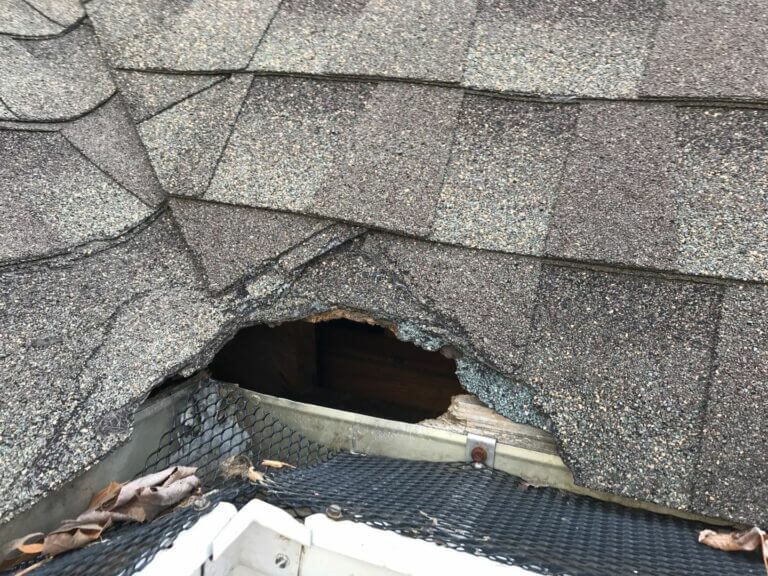
Older city roofs were often installed over the bones of something else. A slate or tile roof gets converted to asphalt, a rear porch is enclosed and topped with a low-slope membrane, a dormer gets added and flashed by whoever was cheapest that year. Hail finds those seams. The most common storm-related failures we repair inside the city limits are predictable once you know the housing stock.
If water is already coming in, tarping goes on before anything else — any hour, any night, anywhere in the city.
24/7 emergency roof repairDocumentation, adjuster meeting, scope, and the repair or replacement itself, handled by one company.
storm and hail damage repairLeaks, flashing, pipe boots, valleys, and decking work on City of St. Louis homes and flats.
roof repair in St. Louis CityBrittle shingles across multiple slopes usually means replacement, and we will show you the photos behind that call.
roof replacementAfter every damaging storm, out-of-town crews work the city for a few weeks and then leave. John Beal Roofing has been family-run since 1947, is now in its third generation, and is headquartered at 12181 Prichard Farm Rd in Maryland Heights — a twenty-minute drive from most city addresses. We are an Owens Corning Platinum Preferred Contractor, BBB A+ rated, and named to Roofing Contractor Magazine’s Top 100. Qualifying work carries a lifetime workmanship warranty, which only matters if the company that signed it is still here in ten years.
Call (314) 429-6000 and a live person answers, including at 2 a.m. during an active storm. The inspection and the written estimate are free.
Usually you cannot tell from the sidewalk, and that is the problem. Hail bruises the asphalt mat under the granules, so the shingle looks intact from the ground while its service life quietly drops. We chalk a 10-by-10-foot test area on each slope, count and photograph the impacts, and check soft metals like gutter aprons, downspouts, and vent caps, which dent before shingles show anything.
Yes. We document the damage the same way an adjuster does, provide the photo report and scope, and meet the adjuster on the roof so both sides are looking at the same evidence. Claim approval is always the carrier’s decision and we never promise an outcome or offer to cover a deductible.
Yes. Most city buildings are really two roofs — a pitched front slope and a low-slope rear section over the kitchen or porch. Hail behaves differently on each, so we inspect and report on them separately.
That depends on your policy and carrier deadlines, not on us, so check your policy language. Practically, the sooner a roof is documented after a storm the cleaner the file, because later weather keeps adding wear that muddies the picture.
We tell you so in writing. Plenty of city roofs we look at are simply old rather than storm damaged, and that is a repair or replacement conversation, not a claim. A free inspection that ends in "your roof is fine for now" is a normal outcome here.
Serving every neighborhood in the City of St. Louis. Tell us when the storm hit and what you are seeing.
A documented inspection costs nothing and settles the question. You get photographs of every slope and a straight answer about whether a claim is worth filing.