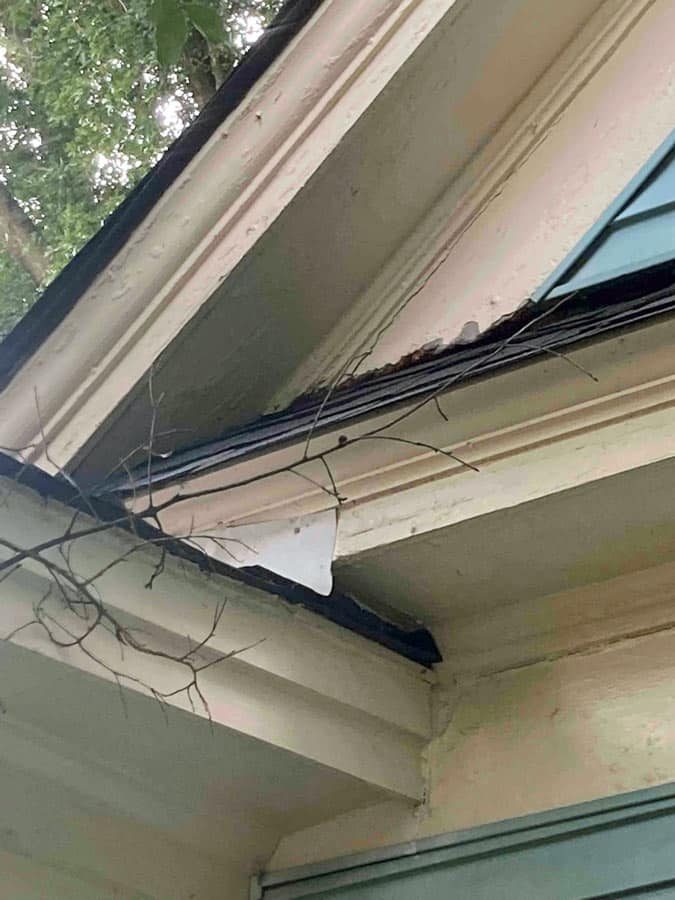
City gutters fail differently than county gutters. Brick, parapets, built-in box troughs and buried clay drain lines all change what the water does when the trough stops working.
Gutter repair in St. Louis City, at a glance
STL Roof Repair repairs, rehangs and replaces gutters on St. Louis City homes and two-families, including the built-in box gutters common on century-old brick houses. As John Beal Roofing — family-run since 1947 and now in its third generation — we inspect the trough, the fascia behind it, the drip edge above it and the buried downspout line below it, then give you a written price at no cost. Call (314) 429-6000 any hour to get on the schedule.
Most of the housing stock inside the city limits predates the aluminum gutter entirely. On the brick two-families of south city, the shotguns off Cherokee, the four-families in Dutchtown and the big homes around Compton Heights and Shaw, water was originally handled either by a built-in box gutter framed into the cornice or by a half-round hung off ornamental brackets. Both systems work well when they are maintained and both fail quietly when they are not, because the leak does not land on the ground where you would see it. It lands inside the cornice, behind the brick, or down the back of a parapet wall.
That is the difference between a city gutter call and a subdivision gutter call. In a newer neighborhood a failed gutter stains the siding and erodes the mulch. On a century-old brick house the same failure soaks the wood cornice, rots the rafter tails hidden behind it, saturates the mortar joints and eventually shows up as a damp interior wall two stories below the actual problem. By the time a homeowner calls us about a wet plaster wall in an upstairs bedroom, the gutter has usually been failing for two or three seasons.
What Fails Here
Failure Modes We See On City Gutters
Built-in box gutters with a failed liner
The wood trough is part of the cornice, and the only thing keeping water out of it is the metal or membrane liner inside. Once that liner splits at a seam or a corner, water goes straight into the framing instead of out the downspout.
Rotted fascia and rafter tails
Decades of overflow behind the trough softens the fascia board first, then the tails behind it. Hanging a new gutter on rotted wood just moves the failure date. We replace the wood before we hang anything.
Buried clay downspout tiles
Many city downspouts drop into a clay tile that runs under the sidewalk to the sewer. Root intrusion and silt block those lines, water backs up out of the boot, and the foundation takes it.
Parapet and scupper backups
On flat-back city buildings the water leaves through a scupper in the parapet. When the scupper chokes, water ponds against the wall and pushes through the mortar.
Undersized half-round on steep slopes
Steep city roofs throw water fast. A narrow trough at the bottom of a long steep plane overshoots in any real downpour, which owners often mistake for a clog.
Galvanized troughs rusting from the inside
Original steel gutters rust at the seams and the low end first. Sealant buys a season; replacement is the honest answer once the pitting is through.
Fascia damage behind the trough is the part an owner cannot see from the ground. We check the wood before we quote the gutter.
Our Approach
How We Work A City Gutter
We look behind the gutter, not just in it
Cleaning a trough tells you nothing about the fascia, the drip edge or the liner. A technician gets up, pulls a section where needed and photographs the wood.
We trace where the water actually goes
Downspout, boot, buried tile, splash block, grade. A gutter that discharges into a blocked tile is not fixed, no matter how good the trough looks.
We match the house
On historic city homes that can mean rebuilding a box gutter and lining it rather than bolting a modern aluminum trough onto a decorative cornice. Where seamless is right, we roll it on site to the exact run.
You get the photos and a written price
Free inspection, free written estimate, no obligation, and qualifying work carries our lifetime workmanship warranty.
Access is the other city variable. Alley-only rear elevations, shared walls, tight setbacks and street parking all affect how a crew stages a gutter job, and a contractor who has not worked these blocks tends to underestimate it. We have run crews out of Maryland Heights across the city for decades, and our estimates account for the real approach rather than an ideal one. If the rear of the building is only reachable from the alley, we say so up front and price it that way instead of discovering it on install day.
One more thing worth knowing: gutters and roofs fail together far more often than separately. A gutter that has been overflowing for years has usually been wicking water back under the first course of shingles and into the decking along the eave. When we inspect a city gutter we look at the bottom two feet of roof at the same time, because repairing one and ignoring the other is how a homeowner ends up paying twice.
Free inspection with photographs of the trough, fascia and drip edge
Seamless gutter rolled on site to the length of the run
Box gutter rebuild and re-lining on historic city cornices
Downspout, boot and buried drain-line diagnosis
Leaf guard options for heavy city tree cover
Lifetime workmanship warranty on qualifying work
Common Questions
What City Homeowners Ask About Gutters
Can you repair a built-in box gutter, or does it have to be replaced?
Often it can be repaired. If the wood trough is structurally sound and only the liner has failed, rebuilding and re-lining the trough is usually the right call and it keeps the original cornice intact. If the trough itself is rotted through, that wood has to be rebuilt first. A technician photographs the trough so you can see which situation you actually have before you decide anything.
Water pours out at the bottom of my downspout instead of draining away. Why?
Most likely the buried tile the downspout feeds is blocked with roots or silt, so the water has nowhere to go and comes back out at the boot. That is extremely common on older city blocks. We check the discharge point as part of the inspection and tell you whether the fix is at the gutter, at the boot, or in the line below it.
Do I need 6-inch gutters on a St. Louis City house?
It depends on the roof plane feeding the trough. Steep city roofs move a lot of water very quickly, and a wider trough with properly sized downspouts often solves an overflow that no amount of cleaning would fix. On a decorative cornice, though, the profile also has to suit the house. We recommend based on the actual roof, not a default size.
Will gutter work help a wet basement?
Frequently, yes. If the gutters overflow or the downspouts dump against the wall, you are loading the soil right at the foundation every time it rains. Fixing the discharge is the cheapest thing anyone can do about basement water, and it is worth ruling out before you spend money on anything more invasive.
Is the gutter inspection really free?
Yes. Inspections and written estimates are free with no obligation anywhere in the city. A live dispatcher answers (314) 429-6000 twenty-four hours a day, so you can schedule whenever it is convenient for you.
Free Roof Inspection
Tell us what is going on and we will call to schedule. Inspections are free.