
Parapet and coping failure
Open mortar joints and cracked coping let storm water into the top of the wall, where it runs down inside the masonry and shows up on a bedroom ceiling well away from the roof itself.
St. Louis City roof repairCall (314) 429-6000 — a real person answers 24 hours a day, 7 days a week, in every St. Louis City ZIP. We dispatch emergency crews for active leaks, wind-stripped shingles, failed parapet and coping details, and flat rear-porch roofs that have opened up, and we tarp to divert water away from the attic, the joist bays and the plaster below until the permanent repair is scheduled. Inspections and written estimates are free, and John Beal Roofing has answered that phone as a family-run company since 1947.
St. Louis City is not a subdivision, and city roofs do not fail the way suburban roofs fail. Most of the housing stock south and north of downtown — the brick two-flats and four-families of Dutchtown, Bevo, Tower Grove South, Benton Park, Carondelet, Baden and The Ville — was built before the Second World War, and a large share of it carries a low-slope or nearly flat roof hidden behind a parapet wall you cannot see from the sidewalk. That geometry is the single biggest reason city emergency calls come in the way they do: nothing drips for years, then one storm overwhelms an interior drain or a scupper and the ceiling in the front room lets go all at once.
The second reason is age at the details. On a hundred-year-old building the field of the roof is often not the failure point — the coping stone, the mortar joint behind it, the chimney flashing, the box gutter and the seam where a rear addition meets the main house are. Water gets behind masonry that has not been tuckpointed in decades, tracks down inside the wall cavity, and surfaces three rooms away from where it entered. When you call us at midnight in the city, the first thing we are trying to establish on the phone is whether we are chasing a surface breach we can tarp or a masonry path we need to divert around. Both get stabilized the same night; only one of them is fixed with shingles.
No voicemail and no overnight answering script. They take the address, the nearest cross street, and whether water is actively running into the building right now.
Active interior water and anything unsafe on a public sidewalk moves to the front of the queue. You get a realistic arrival window for the conditions, not a number invented to end the call.
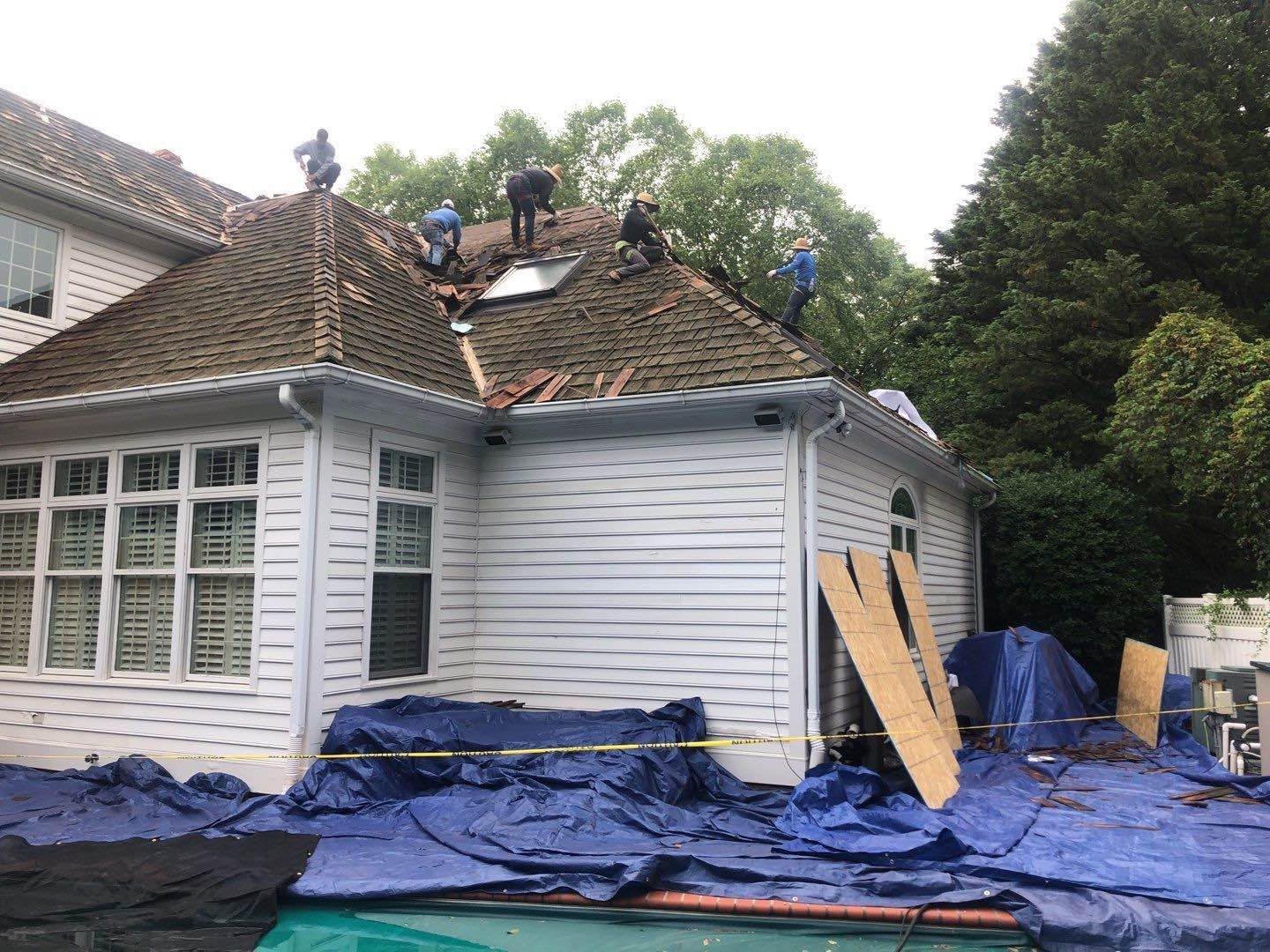
Tarping run from the high side down, loose slate or shingle made safe, debris cleared off parapets and gutters, and every failure photographed for your file before anything is covered.
Once the building is dry we come back in daylight and price the real fix in writing — and if a storm caused it, our insurance team handles the adjuster meeting.
Open mortar joints and cracked coping let storm water into the top of the wall, where it runs down inside the masonry and shows up on a bedroom ceiling well away from the roof itself.
St. Louis City roof repairThe low-slope roof over a back porch or kitchen addition is usually the oldest surface on a city property, and it ponds. When it opens up the water lands directly in the ceiling below.
flat and low-slope roofingStraight-line winds peel courses off exposed dormers and steep front slopes. On older slate and tile, one displaced piece opens a direct path to the decking.
storm damage repairBuilt-in box gutters and interior roof drains back up with leaves and grit, and the overflow goes into the structure instead of the street.
gutter repair and leaf guards
| Phone | (314) 429-6000, answered by a live person 24 hours a day, 365 days a year |
|---|---|
| Coverage | All St. Louis City neighborhoods, plus St. Louis County and Metro East Illinois |
| First response | Emergency tarping and water diversion to stop interior damage |
| Documentation | Photographs of every failure point before the tarp goes down |
| Property types | Single-family, two- and four-family flats, mixed-use storefronts, low-slope and membrane roofs |
| Follow-up | Free daylight inspection and a written estimate for the permanent repair |
| Warranty | Lifetime workmanship warranty on qualifying work |
After a big storm, out-of-town crews work the city for a few weeks and then leave. We are not a storm-chasing outfit. John Beal Roofing has been family-run and third-generation since 1947, works out of Maryland Heights with additional offices in Chesterfield, Festus and Edwardsville, and is an Owens Corning Platinum Preferred Contractor and BBB A+ rated. That matters most on a city building, where the right answer is sometimes not a new roof at all but a flashing detail and a masonry repair — and where you need the company that did the emergency tarp to still be answering the phone next winter.
Related: roof repair in St. Louis City, our metro-wide 24/7 emergency roof repair service, storm and hail damage restoration, and commercial and flat roof repair for city storefronts and multi-family buildings.
Yes. (314) 429-6000 is answered by a live dispatcher at any hour, on weekends and holidays, including during an active storm. You will not get voicemail or an after-hours message service.
Yes. Low-slope and parapet-walled city roofs are a large share of what we tarp. The approach is different from a steep slope — we divert water toward a working drain or scupper and secure the tarp so it does not lift — but it is routine work for our crews.
The roof inspection and the written estimate are always free. Emergency stabilization work is quoted to you before we do it, so nothing happens on your building at 2 a.m. that you have not agreed to.
Yes, and it is common in the city. We trace the actual water path rather than assuming it is shingles. If the entry point is a flashing detail, a coping stone or an open mortar joint, we tell you that and photograph it instead of selling you a roof you do not need.
Often, when the damage came from a covered storm event. We photograph every failure before the tarp goes on so the claim file is complete, and our insurance division can meet the adjuster with you. Payouts are never guaranteed and deductibles are never waived.
Serving every St. Louis City neighborhood. Tell us what is happening and we will call to schedule. If water is coming in right now, call (314) 429-6000 instead.
A live dispatcher answers day or night and gets emergency tarping onto your roof. Inspections and written estimates are free.