
Valleys firing into three feet of trough
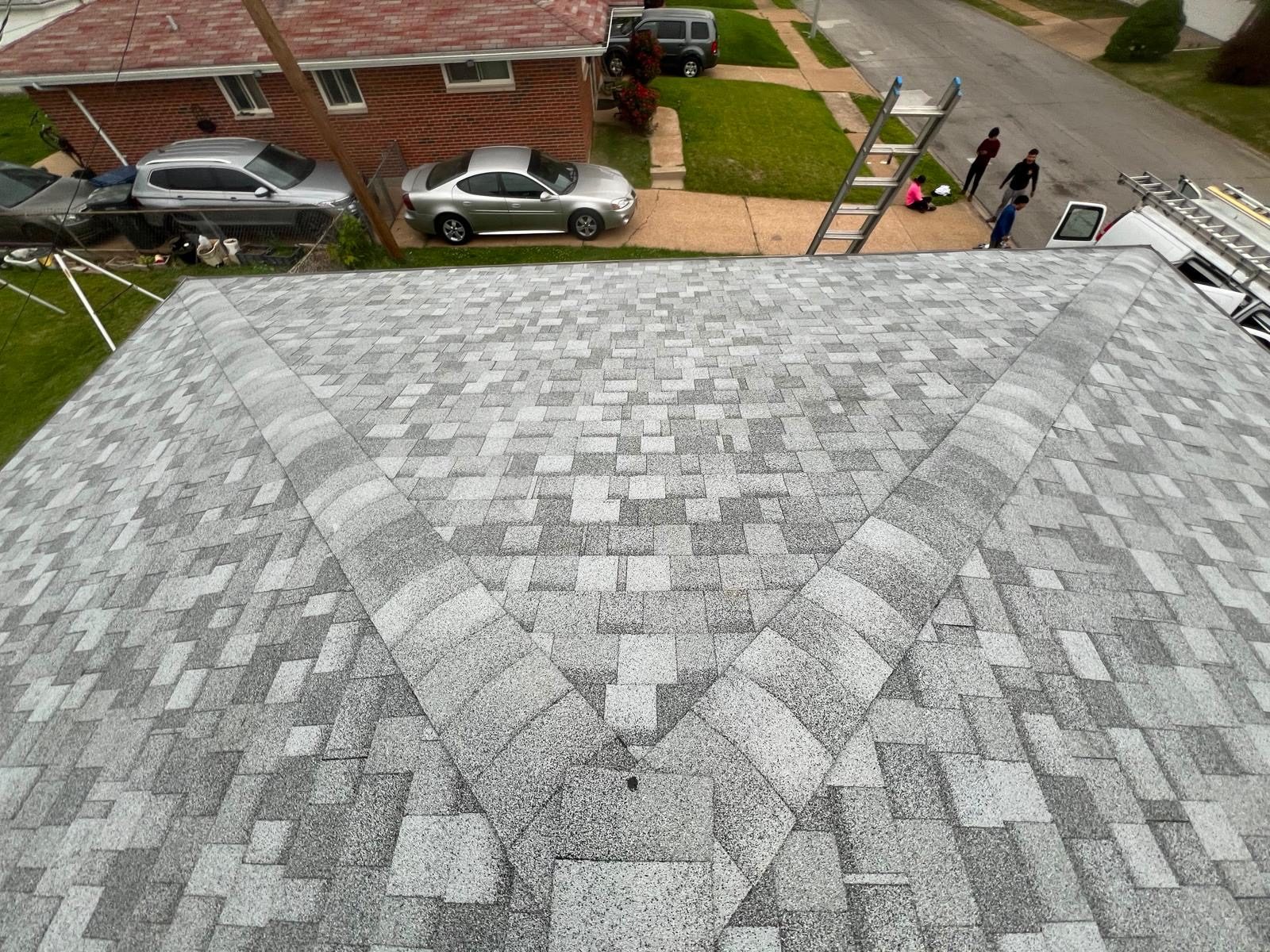
A long steep valley concentrates the runoff of a huge roof area into one point. Standard outlets cannot swallow it fast enough.
STL Roof Repair repairs gutters and installs oversized seamless gutters and downspouts on Chesterfield, Missouri homes, sized to the valleys and roof planes that are actually feeding them. We are John Beal Roofing — family-run since 1947, third-generation, with an office right here in Chesterfield — and inspections and written proposals are free. Call (314) 429-6000 at any hour.
The homes that went up across Chesterfield from the 1980s onward were designed for curb appeal from the street: multiple gables, cross-hips, front-facing dormers, two-story entries and steep pitches. Architecturally that works. Hydraulically it concentrates water. Every valley on that roof is a funnel, and a valley that drains eight or nine hundred square feet of steep plane delivers all of it into perhaps three feet of trough at the bottom. In a hard Missouri thunderstorm that section is handling more water per minute than an entire ranch roof in Florissant.
So when a Chesterfield homeowner tells us water is sheeting over the front gutter, the trough is usually spotless. It is not blocked, it is outmatched. The correct answer is capacity and geometry: a wider trough on the affected run, an oversized outlet or a second downspout, and sometimes a valley diverter to spread the discharge across more of the gutter instead of firing it at one spot. Cleaning that gutter every spring for another decade would never have changed anything.
A long steep valley concentrates the runoff of a huge roof area into one point. Standard outlets cannot swallow it fast enough.
Water comes off a 9- or 10-pitch roof fast enough to jump the trough entirely if the gutter sits slightly low or slightly narrow.
An upper roof discharging onto a lower gutter doubles that run's load. It needs its own path down, not a shared one.
Fifty-foot eaves on these houses are common. One outlet at one end guarantees a backup at the far end in heavy rain.
Water shed around a chimney cricket or a bank of skylights lands in a predictable spot. That spot is usually where the trough fails first.
West-facing elevations in west county take the leading edge of storms. Dented troughs and loosened straps belong in the storm documentation.
We identify which planes and valleys drain where, so the trough and outlets get sized to real load instead of a default package.
Often only two or three runs on a house need a wider trough or another downspout. We do not sell you a whole-house upsize to fix a front gable.
Where a second story dumps onto a lower roof, we route that water so it is not overwhelming a run designed for one plane.
Fascia, drip edge and any soffit damage get documented and repaired as part of the same written proposal.
Access and height are practical factors on these houses. Two-story entries, rear elevations that fall away down a slope, and steep unwalkable pitches all affect how a crew works safely, and that belongs in the estimate honestly rather than as a surprise. Our crews work these roofs constantly out of the Chesterfield office, so the price we write is the price for the house you actually own, including the elevation that only reaches from a ladder set on a hill.
One thing worth flagging for anyone in a newer Chesterfield subdivision: the gutters and the roof on these homes are often the same age, and neither was chosen by you. If the shingles are approaching the end of their service life, doing the gutter work at the same time as a replacement means the drip edge, the ice-and-water shield at the eave and the new trough all get detailed together. If your roof has real years left, we will simply fix the gutters and tell you so. A no-cost assessment with photographs is how you find out which situation you are in.
Almost always capacity rather than blockage. A steep Chesterfield roof with long valleys concentrates a very large amount of water into a short section of trough, and a standard five-inch gutter with one outlet cannot move it fast enough. The fix is a wider trough, a larger or additional outlet, and sometimes a diverter in the valley. We measure the roof area feeding that run so the recommendation is based on numbers, not a guess.
On the runs that are actually overloaded, yes — they carry meaningfully more water and take bigger outlets. On the runs that are fine, they are an unnecessary expense. That is why we quote by run rather than selling a whole-house upsize, and you will see in the photos which elevations need it.
Yes. When water backs up in a trough or runs behind it, it wicks under the first course of shingles and into the sheathing along the eave. On a two-story that damage sits out of sight for years. Whenever we inspect a gutter we also check the bottom of the roof, because fixing one and ignoring the other is how people end up paying twice.
Yes. Walkout lots, steep grades and unwalkable pitches are normal on these houses, and our crews stage for them rather than skipping them. If an elevation requires extra setup we tell you in the written proposal instead of discovering it on install day.
We do. John Beal Roofing runs a Chesterfield office in addition to our Maryland Heights headquarters, which is part of why west county response times are what they are. The main line, (314) 429-6000, is answered by a dispatcher twenty-four hours a day.
Tell us what is going on and we will call to schedule. Inspections are free.
On a steep Chesterfield roof that is almost never a clog. It is capacity, and it is measurable. The inspection is free.