
Stacked recover layers
Two or three systems built up over decades. Water trapped between layers means a surface patch does nothing while the deck below keeps rotting.
STL Roof Repair repairs flat and low-slope roofs in Florissant, Missouri — aging built-up gravel and modified bitumen roofs on older north county buildings, plus the flat porch, carport and addition roofs on postwar ranch homes. John Beal Roofing has worked north St. Louis County from Maryland Heights since 1947, three generations of the same family. Free inspection and written estimate, lifetime workmanship warranty on qualifying work, and a live person on (314) 429-6000 around the clock.
Florissant is older than the subdivisions west of it, and that changes what we find on a low-slope roof. The strip retail along North Lindbergh, the office and church buildings near Washington Street and St. Ferdinand, the service garages and small industrial bays — much of that stock dates to the 1960s and 1970s, when a flat roof meant hot-mopped asphalt and gravel. Those roofs hit the end of their first life long ago, and instead of being torn off they were recovered. Sometimes twice.
So the first question on a Florissant flat roof usually is not where the leak is. It is what is actually up there. A roof carrying three stacked systems is enormously heavy, holds water inside its layers, and cannot be judged from the surface. We cut a small core, look at the cross-section, and tell you what you own before anyone proposes a repair.
Two or three systems built up over decades. Water trapped between layers means a surface patch does nothing while the deck below keeps rotting.
On older north county buildings the wall-to-roof junction starts nearly everything. Deteriorated cant strips and open base flashing let water in behind the membrane.
These buildings drain through leaders inside the walls. A cracked drain bowl leaks into the structure instead of onto the ground, which is why the damage looks nothing like a roof leak.
Bare, alligatored areas where the gravel has migrated. Blisters and ridges are where the plies separated and the roof has no redundancy left.
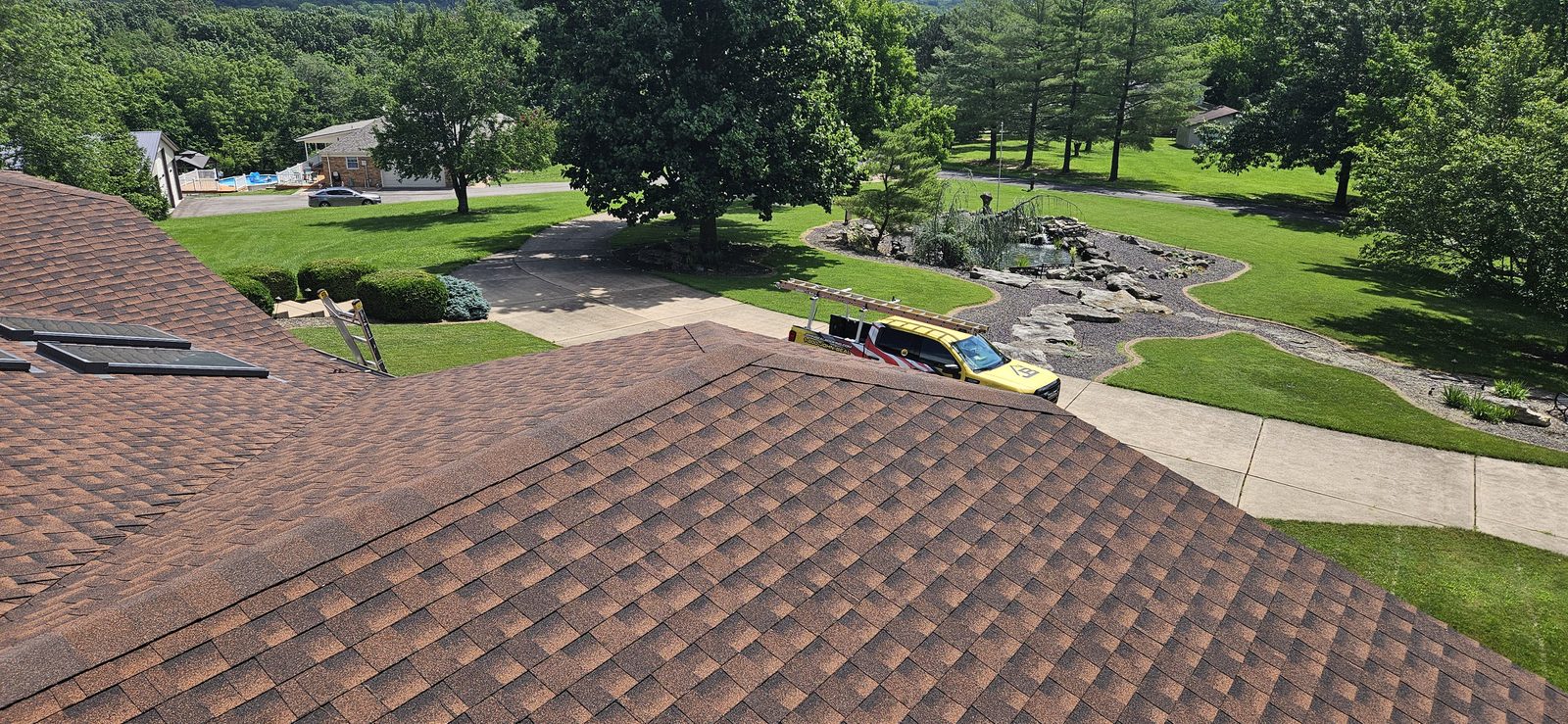
On a Florissant ranch the leak is often not on the flat part at all. It is where the flat part meets something else. A porch roof or a 1960s addition ties into the main shingle slope, and that transition is the most failure-prone detail on the house: shingles lapped over a membrane that was never meant to take the water dumping onto it, junction metal that was face-nailed, and dozens of freeze-thaw cycles a season working it open. Water then runs inside the addition ceiling and shows at an interior wall, so homeowners spend a year chasing a plumbing leak.
Those tie-ins have a correct way to be built — membrane run up under the shingle course with a proper transition flashing, not caulk over a seam. It is unglamorous work and it is most of what fixes these houses for good. Mature oaks and sweetgums make it worse by burying drains and strainers by November, so water backs up and sits on the weakest seam all winter.
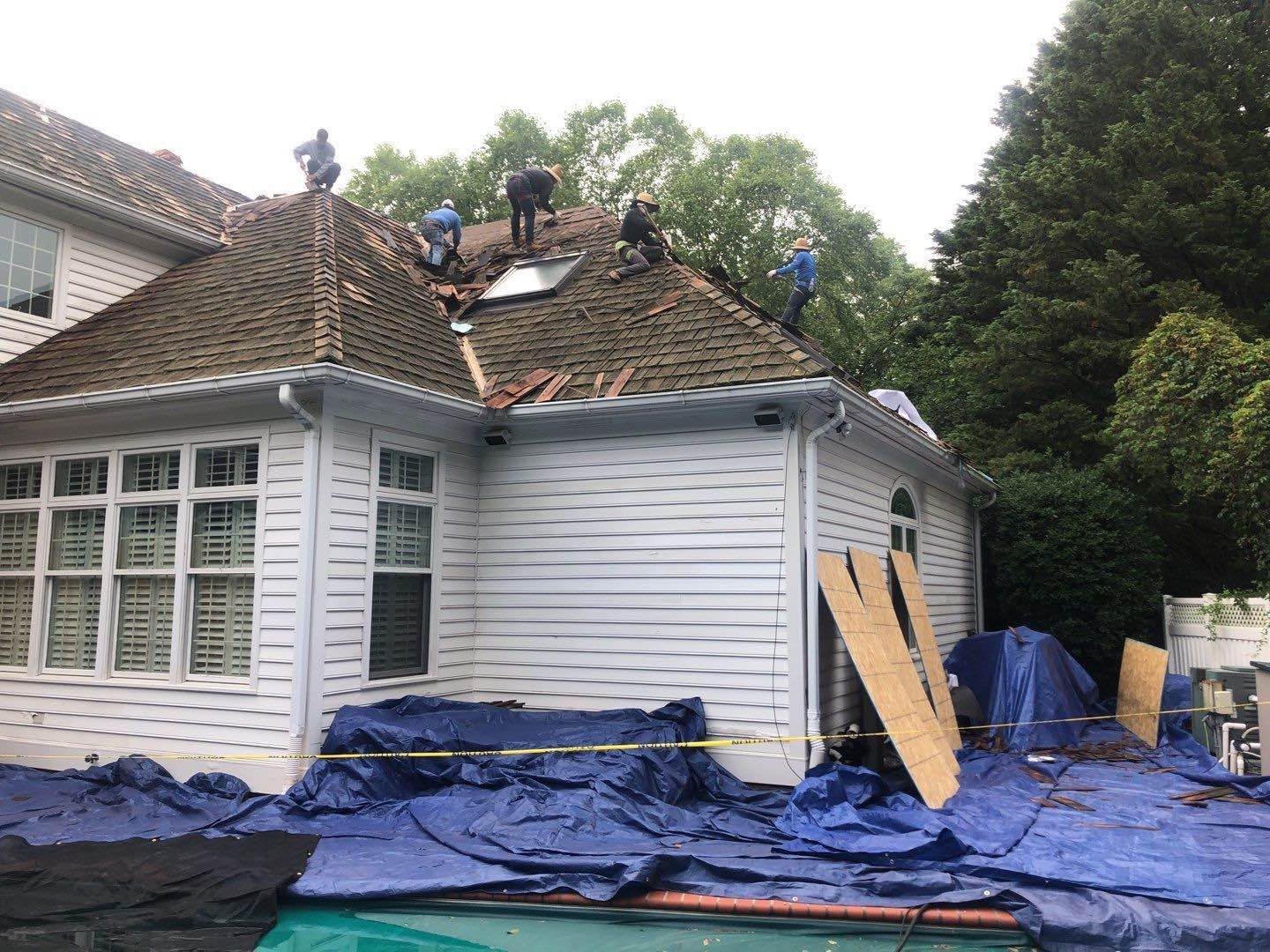
We will not sell a Florissant building owner a fourth recover layer on a roof that already carries three. If the core shows wet insulation and separated plies across the field, the honest answer is a tear-off. If the field is sound and the trouble is confined to flashings, curbs and a drain, we repair those details and the roof goes back to work. Active water coming in is an emergency on any low-slope roof, and a live dispatcher answers (314) 429-6000 at two in the morning.
Yes. A large share of our Florissant low-slope work is residential - flat porch, breezeway, carport and addition roofs on postwar ranches, and especially the transition where a low-slope roof ties into the main shingle slope.
Usually not, and we will tell you before you spend money. Stacked layers trap water and add structural load. We take a small core sample, show you the cross-section, and recommend a tear-off only when that is genuinely what the roof needs.
Older north county buildings drain through interior leaders inside the walls, and water on a low-slope deck travels. A cracked drain bowl or an open parapet flashing can put water two rooms away from the actual failure.
Only over a dry, sound assembly. A coating over wet insulation or separated plies seals moisture in and hides the deterioration, so we core-cut first and will not sell a coating over a wet roof.
Serving Florissant, Hazelwood, Ferguson, Spanish Lake and the rest of north St. Louis County. Tell us where the water is showing up.
One free inspection tells you whether you are buying a repair or planning a replacement. No obligation either way.